

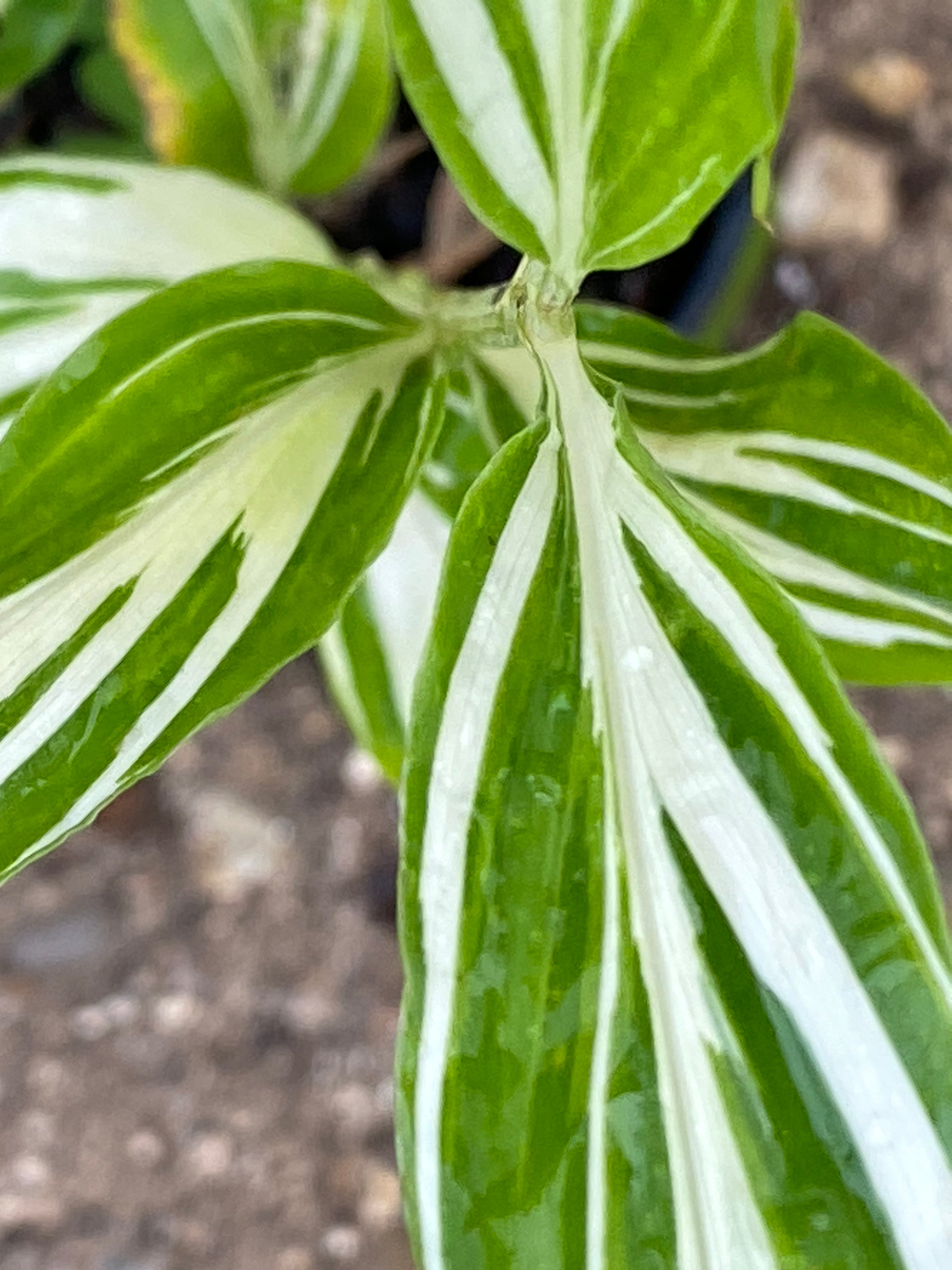
Zingiber mioga ‘Dancing Crane’
Variegated Myoga Zingiberaceae
A ginger with rather more flair than its name suggests. Zingiber mioga ‘Dancing Crane’ forms handsome, upright clumps of green stems carrying long, lance-shaped leaves dramatically marked with broad and narrow white longitudinal stripes. The strongest markings run through the centre of the leaves, giving the plant an almost hand-painted appearance. In late summer and autumn, curious yellow, orchid-like flowers emerge directly from the rhizomes at ground level — as if the plant couldn’t quite decide where flowers should grow. More compact than the species, fast-growing and surprisingly hardy, it makes an excellent foliage plant for the woodland garden.
Introduction: ‘Dancing Crane’ is one of three recognised variegated cultivars of Zingiber mioga, alongside ‘Silver Arrow’ and ‘White Feather’. It is also known as ‘Nakafu’. Plant Delights records the selection as originating from the collection of the celebrated Japanese nursery Gotemba, while the 2014 The Plantsman article by Theodor C. H. Cole and Sven Nürnberger confirms its established status as a cultivar and describes its characteristic combination of narrow and broad white longitudinal markings.
Edible: Like the species, the unopened flower buds and young shoots are edible. The flower buds, known as myoga, are harvested before opening and are used fresh, pickled or cooked, particularly in Japanese cuisine. They have a crisp texture and a fresh, aromatic flavour quite distinct from culinary ginger.
Ethnobotany: Zingiber mioga has long been cultivated as a food and spice plant in Japan. Its flower buds are traditionally sliced and used in soups, noodles and other dishes, while the young shoots are also eaten. The species is additionally recorded in traditional medicine.
Growing conditions: Grow in fertile, humus-rich, moisture-retentive soil in partial shade to light shade. It is fast-growing and spreads steadily by rhizomes, eventually forming a substantial clump. The variegated cultivars are less hardy than the green-leaved forms, so a mulch over the rhizomes is worthwhile in colder or exposed gardens. The foliage is deciduous, dying back in autumn before the rhizomes re-emerge in spring.
Garden use: A superb woodland and shade-garden plant, particularly effective with ferns, Begonia, Deinanthe and other bold-textured perennials. The central white markings illuminate darker planting without becoming quite as visually dominant as some variegated gingers. And when the curious flowers appear at ground level, there is the added bonus of being able to eat them.
Flowering: August–October
Hardiness: H4–H5, approximately -15 to -10°C
Height: 50–80cm
Spread: 60–100cm
- Standard delivery: £9.99
- Free shipping on orders over £100
- Minimum order is £20
Read more: Shipping & Delivery