

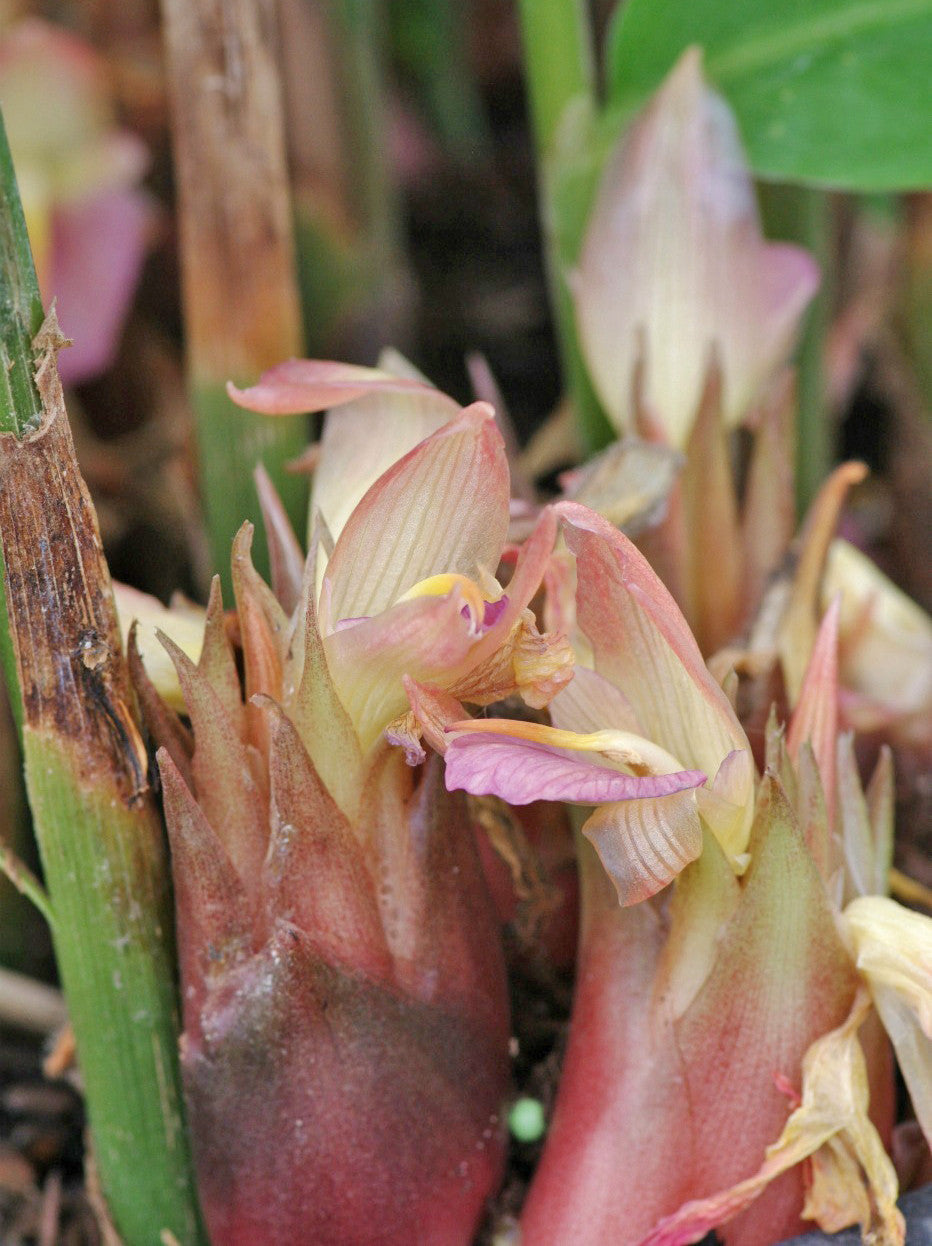
Zingiber mioga ‘Crûg's Zing’ BSWJ4379
Japanese Hardy Ginger or Myoga Ginger Zingiberaceae
Japanese ginger with a difference — this is the one that puts the flower buds on the menu. Zingiber mioga forms handsome, deciduous clumps of upright, yellowish-green stems to around 1m, clothed in long, narrow leaves, while its intriguing flowerheads emerge directly from the ground at the base of the stems. In ‘Crûg’s Zing’, dark yellow buds open to unusual lilac-pink flowers in late summer and autumn. A genuinely hardy ginger, it is surprisingly at home in the British garden, particularly in a moisture-retentive soil in sun or part shade. And yes, the flower buds are edible — so this is one ginger where the best bit is not underground.
Introduction: ‘Crûg’s Zing’ BSWJ4379 was collected by Bleddyn and Sue Wynn-Jones of Crûg Farm in the forests of Cheju-do (Jeju Island), South Korea, where it was found growing close to a dried riverbed. The collection formed a clump of thick perennial rhizomes, with stems to approximately 1m and flowers opening lilac-pink from dark yellow buds. Crûg Farm subsequently introduced it into cultivation as an unusually hardy and ornamental form of Z. mioga.
Edible: Unlike culinary ginger (Zingiber officinale), Z. mioga is primarily grown for its immature flower buds and young shoots, rather than its rhizomes. The flower buds are harvested before opening and used fresh as a garnish, particularly in Japanese cuisine, where myoga is prized for its crisp texture and distinctive aromatic flavour. The young shoots are also eaten as a vegetable or flavouring. Crûg Farm specifically records ‘Crûg’s Zing’ as traditionally grown for its edible flower buds and flavoursome shoots.
Ethnobotany: Myoga has a long culinary tradition in Japan and elsewhere in East Asia. The unopened flower buds are finely sliced and used with soups, noodles, tofu, sushi and other dishes, providing a fresh, aromatic flavour somewhat reminiscent of ginger but distinctly its own. The young shoots are likewise used as food. The plant therefore has genuine ethnobotanical importance rather than being merely an ornamental curiosity.
Growing conditions: Grow in a fertile, humus-rich, moisture-retentive soil in sun to part shade. It appreciates good summer moisture but does not require a dry winter. The thick rhizomes gradually form substantial clumps, and a mulch in colder gardens is useful, particularly while plants establish. Despite its distinctly tropical appearance, ‘Crûg’s Zing’ has proved exceptionally hardy, with Crûg Farm recording survival to approximately -23°C.
Garden use: An excellent choice for woodland edges, shady edible gardens and bold herbaceous planting. The tall, corn-like stems provide structure through summer, while the ground-level flowerheads are one of those botanical surprises that demand closer inspection. Particularly useful for the gardener who likes their exotic-looking plants to have a practical side.
Flowering: Late summer–autumn
Hardiness: H5, approximately -15 to -10°C; reported to -23°C
Height: 100–120cm
Spread: 60–100cm
- Standard delivery: £9.99
- Free shipping on orders over £100
- Minimum order is £20
Read more: Shipping & Delivery