

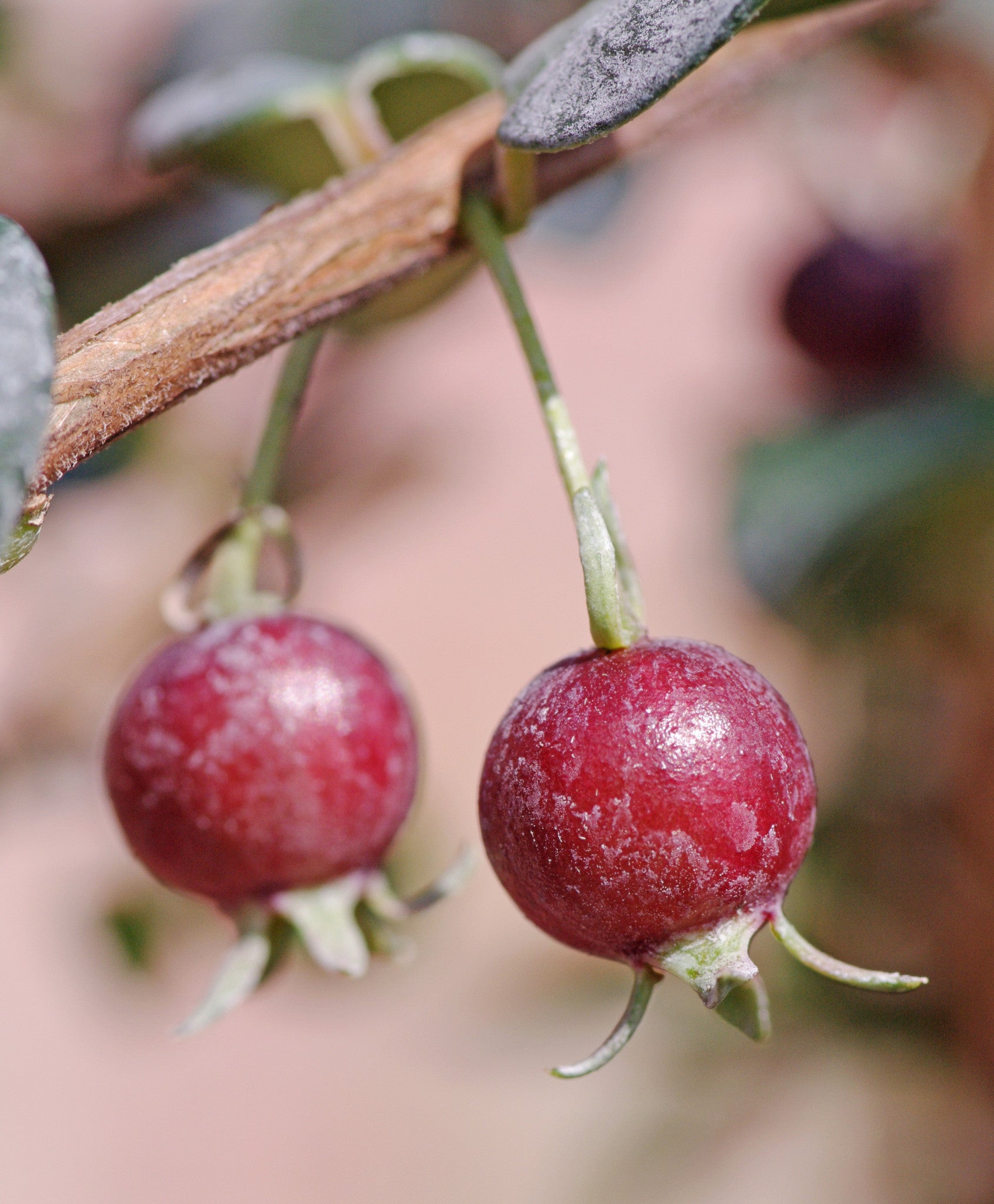
Ugni molinae
Chilean Guava Myrtaceae
One of the great underused edible evergreens, Ugni molinae is a small, densely branched shrub from southern Chile and adjacent Argentina, where it grows in woodland, scrub and open ground. Its small, glossy, leathery leaves form a neat evergreen framework, while the young shoots often carry attractive reddish tones. In summer, delicate, nodding, white to pink-tinged flowers appear, each with a conspicuous boss of stamens, followed by the real prize: small, intensely aromatic, deep red to purplish berries.
The fruits are exceptionally good, with a complex flavour variously likened to strawberry, guava, pineapple and spice. They can be eaten fresh straight from the bush, where their intense perfume makes them particularly addictive, or used for jams, jellies, syrups, desserts, drinks and liqueurs. In Chile they are traditionally known as murta or murtilla, while the Mapuche name is uñi.
Its edible history is much older than its use as a garden plant. The Mapuche have traditionally gathered the berries both fresh and dried, and historical accounts record their use in sweet preparations and a fragrant fermented drink. The leaves have also been used as an infusion, while roasted seeds have traditionally been employed as a coffee substitute.
The fruit has an intriguing royal history: following its introduction to Britain by William Lobb in 1844, Ugni molinae became reputedly one of Queen Victoria’s favourite fruits, with berries grown in the mild climate of Cornwall reportedly being sent to London for the royal table.
There is considerable modern interest in Ugni molinae as a functional fruit, owing to its high concentrations of polyphenols, anthocyanins and other antioxidant compounds. Research has investigated both the fruit and leaves for their bioactive properties, although these findings should not be confused with established medicinal treatments.
Despite its South American origins, it makes an excellent garden plant in Britain when given a sheltered position, preferably against a wall or in a mild coastal or southern garden. It appreciates fertile, moisture-retentive but well-drained soil and sun or light shade. The RHS currently rates it H4, hardy to approximately −10 to −5°C, rather than H6; cold, drying winds are particularly damaging to this evergreen species.
An especially useful feature for the edible garden is its compact stature. Plants normally reach around 1–1.5m high and 0.5–1m wide, making them suitable for smaller gardens and containers as well as the mixed shrub border. The combination of evergreen foliage, attractive flowers and genuinely excellent fruit makes this a plant deserving far wider cultivation.
Height: 1–1.5m
Spread: 0.5–1m
Flowering: Summer
Fruiting: Late summer–autumn
Hardiness: RHS H4 (−10 to −5°C)
Aspect: Sun or partial shade
Soil: Moist but well drained
Origin: Chile and southern Argentina
Nomenclature: Ugni molinae Turcz.; commonly encountered under the older synonyms Myrtus ugni and Eugenia ugni. The genus name Ugni itself derives from the Mapuche name uñi.
- Standard delivery: £9.99
- Free shipping on orders over £100
- Minimum order is £20
Read more: Shipping & Delivery