

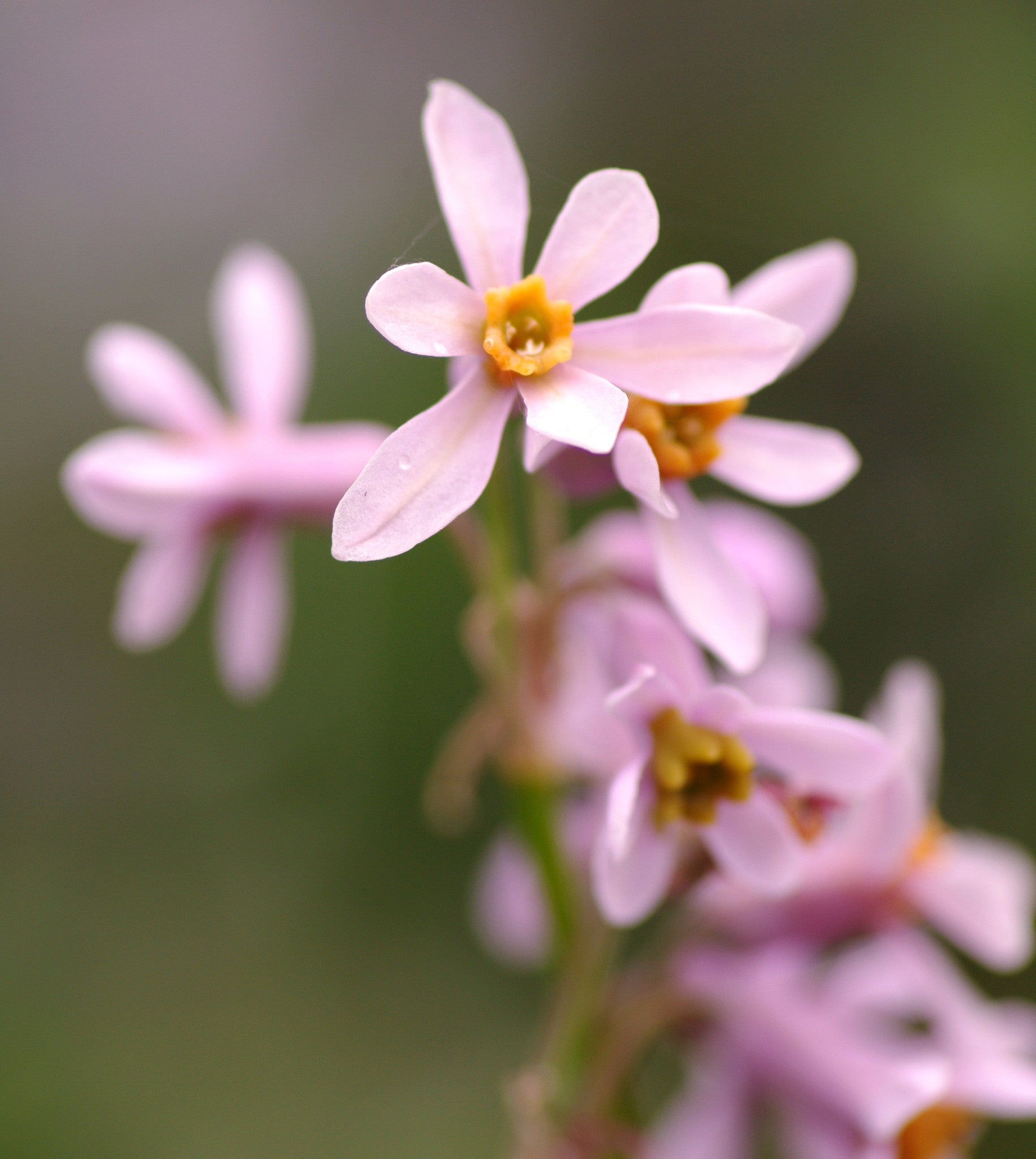
Tulbaghia natalensis
Society Garlic Amaryllidaceae
A particularly attractive and fragrant species, Tulbaghia natalensis forms a clump of erect, glaucous-green, strap-shaped leaves, each only 4–7 mm wide, from a thick rhizomatous rootstock. From late spring through summer it produces upright stems bearing umbels of pale pink to pinkish-white flowers, each with a distinctive greenish-yellow central ring. The flowers are notably fragrant in the afternoon and evening, with a scent reminiscent of sweet almonds.
Unlike the relatively dry-ground Tulbaghia often encountered in cultivation, T. natalensis is naturally associated with moist grassland, marshy ground and rocky places near water, occurring at approximately 800–1800m in the Drakensberg and Midlands of KwaZulu-Natal and the Eastern Cape. This is an important clue to its cultivation: it appreciates considerably more moisture during growth than many of its relatives, provided the soil remains well drained.
Give it full sun or light shade, a fertile soil enriched with compost and reliable moisture during spring and summer. In cultivation it should not be treated as a dry-border Tulbaghia; a position where the soil remains reasonably moist through summer will produce the best growth and flowering. The RHS recommends well-drained loam or sand and rates it H2, so in Britain it is best grown in a sheltered position with winter protection, particularly in containers or wetter gardens.
There is also good ecological interest here: solitary bees and honeybees are the principal pollinators, attracted by the fragrant flowers and rewarded with both nectar and pollen; butterflies, moths and other insects may also visit.
Nomenclature
Tulbaghia natalensis was described by John Gilbert Baker, and was first published in the Gardeners’ Chronicle, series 3, volume 9, page 668, in 1891. Kew currently accepts the name without qualification.
The epithet natalensis means “from Natal”, referring to the former name of the region now largely corresponding to KwaZulu-Natal, where the species is native.
It is endemic to South Africa, restricted to the Eastern Cape and KwaZulu-Natal, and is currently assessed as Least Concern.
Height: 40–50cm
Spread: 30–40cm
Flowers: May–August
Position: Full sun or light shade
Soil: Fertile, moisture-retentive but well drained
Hardiness: H2; protect from hard frost
Growth: Evergreen in its native climate; may become partially dormant in colder British winters
Pollinators: Solitary bees, honeybees, butterflies and moths
A choice and unusually fragrant Tulbaghia, particularly valuable for a warm, sheltered position where its delicate pink flowers can be enjoyed at close quarters. Its preference for moist grassland also makes it quite different culturally from the better-known T. violacea.
- Standard delivery: £9.99
- Free shipping on orders over £100
- Minimum order is £20
Read more: Shipping & Delivery