

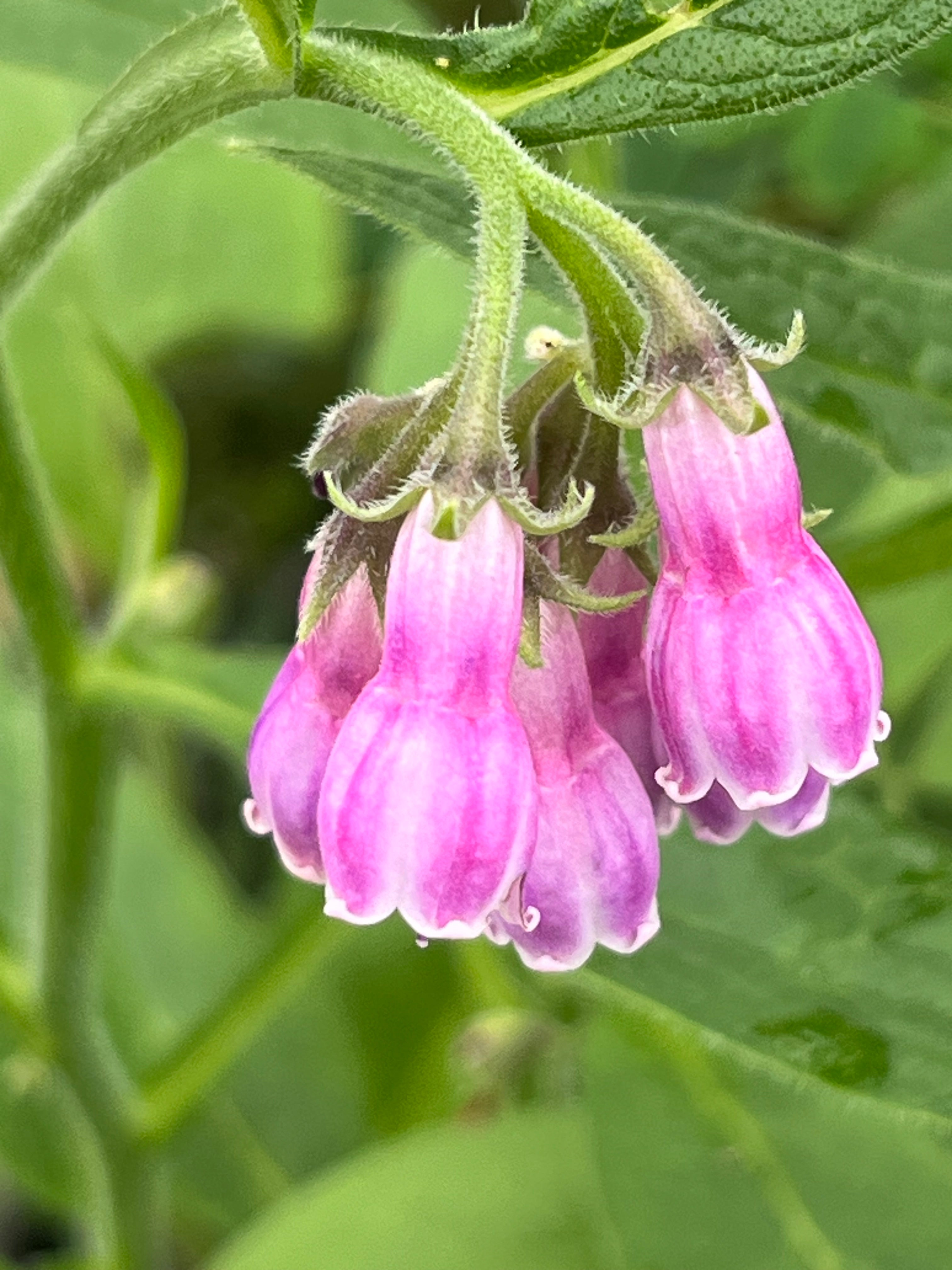
Symphytum x uplandicum ‘Bocking 14’
Russian Comfrey Boraginaceae
Symphytum × uplandicum ‘Bocking 14’ is the comfrey that turned a rather ordinary garden plant into an institution. A vigorous, deep-rooted hybrid of S. officinale × S. asperum, it produces great clumps of large, rough, hairy leaves and upright stems bearing nodding purplish-pink to blue-purple flowers in late spring and early summer. It is an exceptionally productive plant, capable of producing enormous quantities of foliage which can be repeatedly cut for mulch, compost and liquid plant feed. The RHS gives mature plants a potential height of 1.5–2.5 m, although around 1–1.5 m is a more usual garden height.
Its story is inseparable from Lawrence D. Hills, the pioneering organic gardener and founder of the Henry Doubleday Research Association. Hills began serious work with comfrey in the late 1940s, inspired partly by the earlier work of Henry Doubleday, who had introduced Russian comfrey to Britain in the nineteenth century. In 1954 Hills established his experimental comfrey plots at Bocking in Essex, collecting and comparing numerous strains and eventually selecting and numbering them ‘Bocking 1’, ‘Bocking 2’ and so on.
Of the strains Hills investigated, Bocking 14 emerged as his outstanding all-rounder for garden use. It combined vigorous growth and heavy leaf production with good disease resistance and, crucially, produces little or no viable seed. Thus it can be propagated from pieces of root or crown but does not behave like ordinary comfrey, which can turn a small planting into a rather permanent declaration of war. Garden Organic continues to describe Bocking 14 as the most productive of its comfreys for making plant feed.
The association with Hills is particularly appropriate because Bocking 14 was not selected primarily as an ornamental plant. Hills was interested in comfrey as a ‘natural mineral mine’: a crop capable of producing large quantities of nutrient-rich biomass without relying on imported fertilisers. His trials demonstrated the value of the foliage as a source of plant nutrients, particularly potassium, and Bocking 14 subsequently became one of the defining plants of the modern organic gardening movement. The RHS still describes it as the cultivar Hills found best for making plant feed.
There is some useful nomenclatural history here too. Symphytum × uplandicum is the traditional botanical name for the Russian comfrey hybrid, while ‘Bocking 14’ is a particular sterile clone selected by Hills. It is therefore much more precise to write Symphytum × uplandicum ‘Bocking 14’ rather than simply calling it Russian comfrey.
For the gardener, its greatest virtue is also its greatest warning: it is not small. Give it a decent patch of ground and it will make a magnificent, highly productive colony, but it is best positioned where regular cutting is convenient. The sterile nature means it will not spread by seed, although root fragments can regenerate, so disposal of unwanted pieces still requires a little common sense.
Cultivation: Full sun or partial shade in fertile, moisture-retentive soil. Exceptionally tolerant once established and happy on clay, loam or chalk. Cut hard several times during the growing season to obtain fresh foliage for composting or liquid feed. Propagate by root cuttings or division; do not expect it to come true from seed, as the clone is effectively sterile.
Height: 1–1.5 m, occasionally to 2 m+
Spread: 60–100 cm
Flowering period: May–July
Position: Full sun or partial shade
Soil: Fertile, moisture-retentive; tolerant of clay and chalk
Hardiness: H7
Family: Boraginaceae
Common name: Russian comfrey ‘Bocking 14’
Selected by: Lawrence D. Hills, Bocking, Essex, 1950s
Uses: Organic plant feed, mulch, compost accelerator, green manure and biomass crop
- Standard delivery: £9.99
- Free shipping on orders over £100
- Minimum order is £20
Read more: Shipping & Delivery