

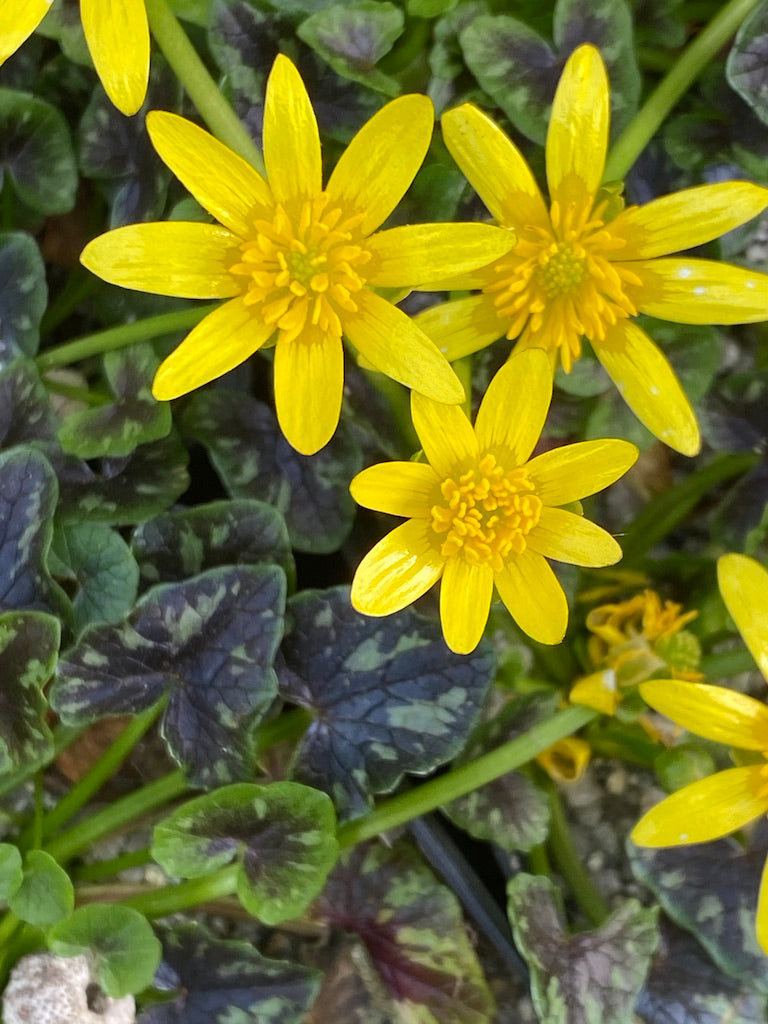
Ficaria verna 'Brambling'
Lesser Celandine Ranunculaceae
A particularly choice form of Lesser Celandine, found by Martin Cragg-Barber of Natural Selection Nursery, Wanborough, growing in a hedgerow. It was selected for its wonderfully distinctive foliage: compact leaves are heavily and irregularly mottled and splashed in silver-grey, green and purple-brown, giving the plant an almost tortoiseshell appearance. The bright, shining yellow flowers appear in early spring, but with foliage this good they are almost playing second fiddle.
Cragg-Barber was well known for his fascination with naturally occurring variations in British plants, collecting and propagating unusual forms through Natural Selection and documenting plant aberrations in his newsletter That Plant’s Odd. ‘Brambling’ is very much in keeping with this work — an otherwise familiar wildflower transformed by an exceptional piece of natural variation.
A superb plant for a woodland edge, beneath deciduous shrubs or naturalised through a shady border, where its marked foliage makes an unusually good early-season display. It is a winter-growing, summer-dormant plant and appreciates a moist, humus-rich soil. As with the species, it can spread enthusiastically in favourable conditions, but this particular form is sufficiently handsome to earn its place.
Nomenclature: Traditionally Ranunculus ficaria L.; now generally treated as Ficaria verna Huds. ‘Brambling’.
- Hardiness: H7, below -20°C
- Height: 10–15 cm
- Spread: 20–30 cm
- Flowers: March–April
- Soil: Moist, humus-rich
- Aspect: Partial shade to shade
- Foliage: Deciduous, strongly mottled silver, green and purple-brown
- Standard delivery: £9.99
- Free shipping on orders over £100
- Minimum order is £20
Read more: Shipping & Delivery