

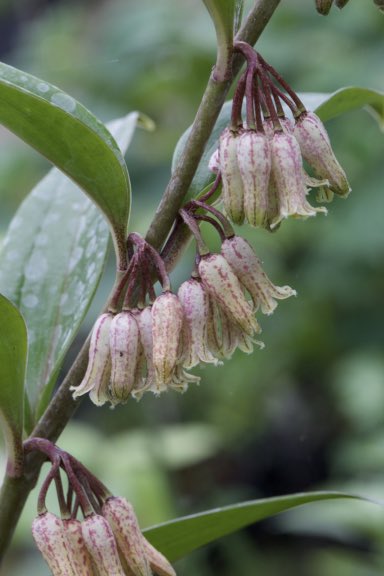
Polygonatum tesselatum
Solomon’s Seal Asparagaceae
A Solomon’s seal that clearly prefers life off the ground! Polygonatum tessellatum is an unusual and rarely cultivated species, producing slender, arching stems with clusters of leaves towards their upper portions. Several pendent flowers arise from the leaf axils, followed by attractive red berries. Unlike most cultivated Solomon’s seals, it is naturally epiphytic or lithophytic, growing amongst moss and organic debris on trees and rocks.
Its range extends through north-eastern India, Myanmar and south-central China, particularly Yunnan. In India it is a very rare species, historically known from Manipur but not recorded there for almost a century.
Our material was raised from seed originally collected by Paul Barney at Shirui (Siroi), Manipur, in 2012. This is particularly significant because the species was subsequently reported as rediscovered in Manipur after a 97-year gap. The 2017 botanical rediscovery was made by Narayanasamy Dhatchanamoorthy, Kaliamoorthy Ravikumar and Natesan Balachandran, who confirmed the identity of the plants against herbarium material. The published account also acknowledges that Paul Barney had previously reported the Shirui material to Aaron Floden, who subsequently recognised P. tessellatum as a new record for India. Thus, the cultivated material offered here represents the earlier 2012 Barney collection, rather than material resulting from the later botanical rediscovery.
Best grown in moist, humus-rich but sharply drained soil in partial shade, with protection from prolonged winter wet. Its natural epiphytic habit suggests that excellent drainage and a generous supply of organic matter are more important than constantly wet soil.
- Height: 40–60cm
- Spread: 30–45cm
- Flowering: May–June
- Hardiness: H6 (-20 to -15°C)
- Position: Partial shade to shade
- Soil: Humus-rich, moist but very well drained
- Collection: Paul Barney, 2012
- Provenance: Shirui (Siroi), Manipur, north-eastern India
- Habit: Naturally epiphytic or lithophytic
- Introduction: Raised from seed from the 2012 Barney collection
- Rediscovery: Scientifically rediscovered in Manipur in 2017 after 97 years by Dhatchanamoorthy, Ravikumar & Balachandran
- Nomenclature: Polygonatum tessellatum F.T.Wang & Tang
- Standard delivery: £9.99
- Free shipping on orders over £100
- Minimum order is £20
Read more: Shipping & Delivery