

Alkekengi officinarum var. franchetii 'Monstrosa'
Chinese Lanterns Solanaceae
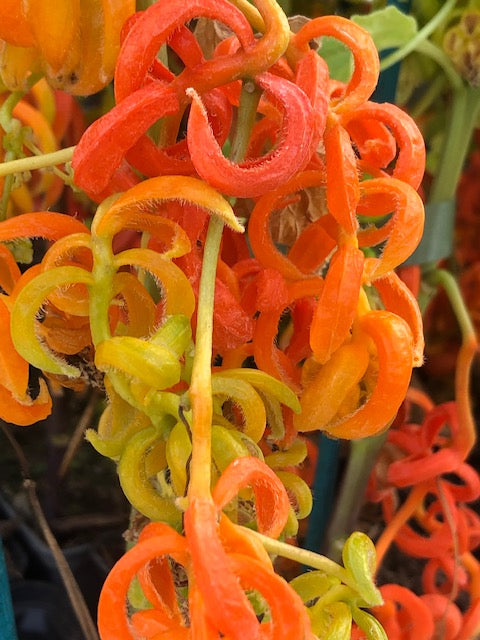
A wonderfully eccentric form of the Chinese Lantern, producing the familiar papery orange lanterns but with the calyces often grotesquely enlarged, distorted and irregularly lobed — as though the plant has decided that a perfectly respectable lantern is simply not theatrical enough. The lanterns develop from small, rather inconspicuous white flowers in summer, gradually swelling as the papery calyx encloses the developing berry before colouring brilliant orange-red in late summer and autumn. The effect is particularly good when several stems are allowed to develop together, and the lanterns persist well into autumn, often making an excellent dried arrangement.
The stems are upright and somewhat branching, clothed in broad, ovate green leaves, and the plant spreads steadily by creeping rhizomes to form a substantial colony. It is an excellent choice for the back of a sunny or partially shaded border, particularly where its somewhat exuberant habit can be allowed to roam. Give it a reasonably fertile, moisture-retentive soil and it is remarkably accommodating; once established it is also decidedly difficult to persuade to leave. In other words, plant it where you actually want it.
Height: 50–75cm
Spread: 60–100cm
Flowering: June–July, with ornamental lanterns developing August–October
Hardiness: H6, approximately –20 to –15°C
Nomenclature: The Chinese Lantern has traditionally been known as Physalis alkekengi L., but Kew’s current treatment places it in the separate genus Alkekengi, as Alkekengi officinarum Moench. Physalis alkekengi is therefore a synonym of the accepted name. The variety franchetii was originally described as Physalis franchetii Mast. in 1894 and was subsequently treated as Physalis alkekengi var. franchetii; it is now accepted by Kew as Alkekengi officinarum var. franchetii (Mast.) R.J.Wang. The horticultural name ‘Monstrosa’ refers to the conspicuously monstrous or fasciated-looking lanterns and is best retained as a cultivar name rather than treated as a formal botanical variety. Older catalogues may consequently be encountered under several combinations of Physalis alkekengi, Physalis franchetii and ‘Monstrosa’ — a splendid example of how a perfectly straightforward plant can accumulate a rather less straightforward name.
- Standard delivery: £9.99
- Free shipping on orders over £100
- Minimum order is £20
Read more: Shipping & Delivery