

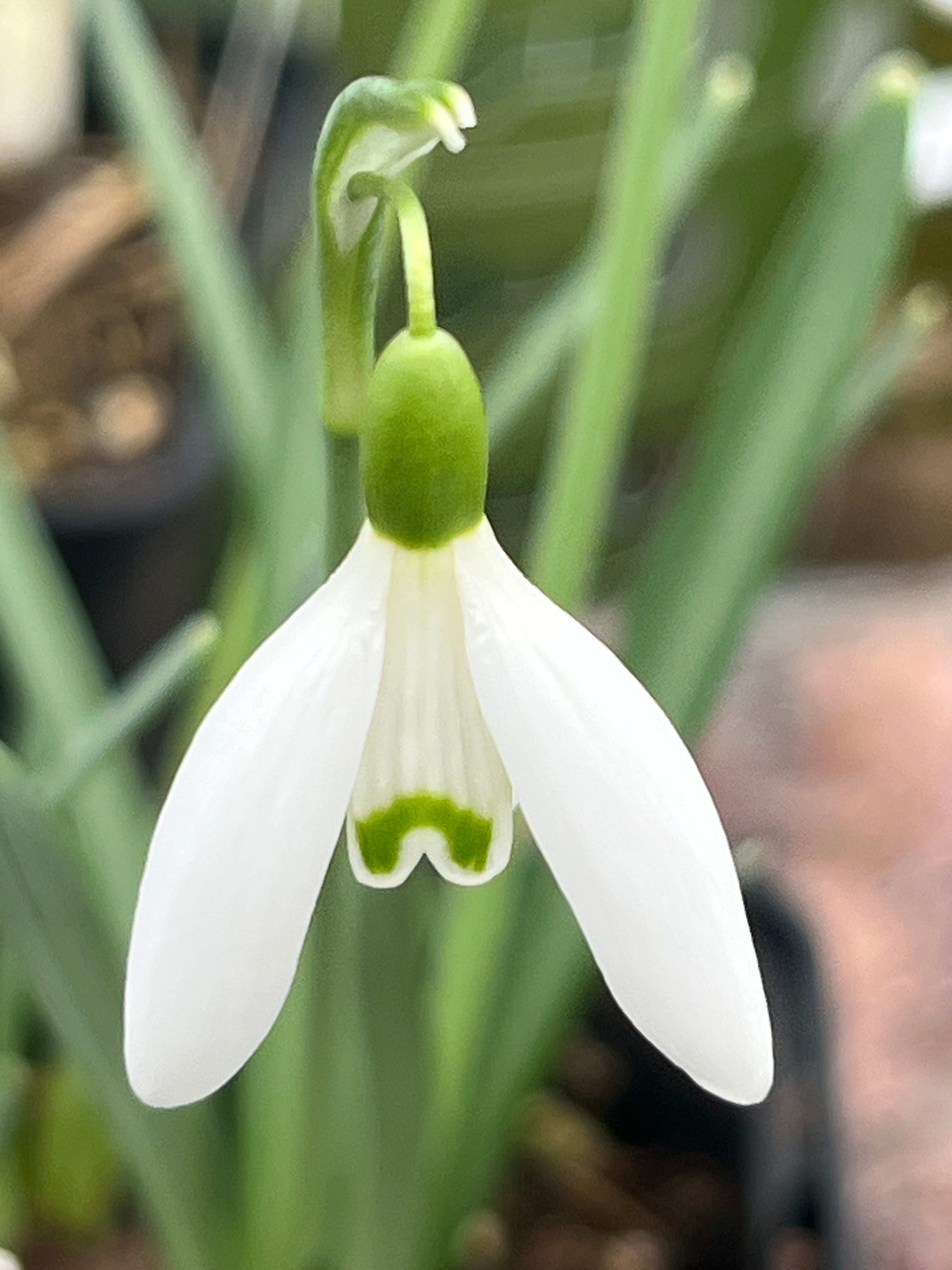
Galanthus ‘Tiny Tim’
One of the smallest forms of Galanthus nivalis, Galanthus nivalis ‘Tiny Tim’ is an irresistibly diminutive snowdrop attributed to Sir W. Lawrence and dating from 1972. The clone now grown under this name is reported to have come from a long-established garden near Darmstadt, Germany, although the name has historically been applied rather loosely to similar small nivalis clones — because apparently even snowdrops occasionally suffer from mistaken identity.
Everything about ‘Tiny Tim’ is reduced in scale. The bulbs are notably smaller than those of ordinary G. nivalis, the leaves are narrow, only around 5–7mm wide, and the flowering stems reach approximately 10–12cm. The flowers themselves are small, around 15mm long, but are produced freely, making established clumps particularly charming. The outer segments are rounded with bluntish tips, while the inner segments carry the characteristic green marking sometimes described in the snowdrop world as a ‘Chinese bridge’. The narrow, upright, blue-green foliage adds to its neat, almost elfin appearance.
Despite its name, ‘Tiny Tim’ is not quite a true miniature in the strictest sense, but it is consistently smaller than most forms of G. nivalis. Its diminutive proportions make it especially effective in troughs, raised beds and the front of a collection, where the flowers can be examined without requiring a magnifying glass — although collectors will probably reach for one anyway.
It is also notably late flowering for G. nivalis, extending the season after many of the early forms have finished. Given time to establish, it produces compact, floriferous clumps that are considerably more impressive than a single bulb might suggest.
A delightful little snowdrop with genuine history and considerably more character than its size might suggest. ‘Tiny Tim’ may be small, but it clearly refuses to be overlooked.
Cultivation: Grow in humus-rich, moisture-retentive but well-drained soil in partial shade or beneath deciduous trees and shrubs. Avoid prolonged summer drought and permanently waterlogged conditions. Allow the foliage to die back naturally after flowering. Particularly well suited to troughs, raised beds, rock gardens and the front of woodland plantings, where its small stature can be appreciated.
Flowering: February–March
Hardiness: H5, approximately −15 to −10°C
Height: 8–12cm
Spread: 10–15cm
- Standard delivery: £9.99
- Free shipping on orders over £100
- Minimum order is £20
Read more: Shipping & Delivery