

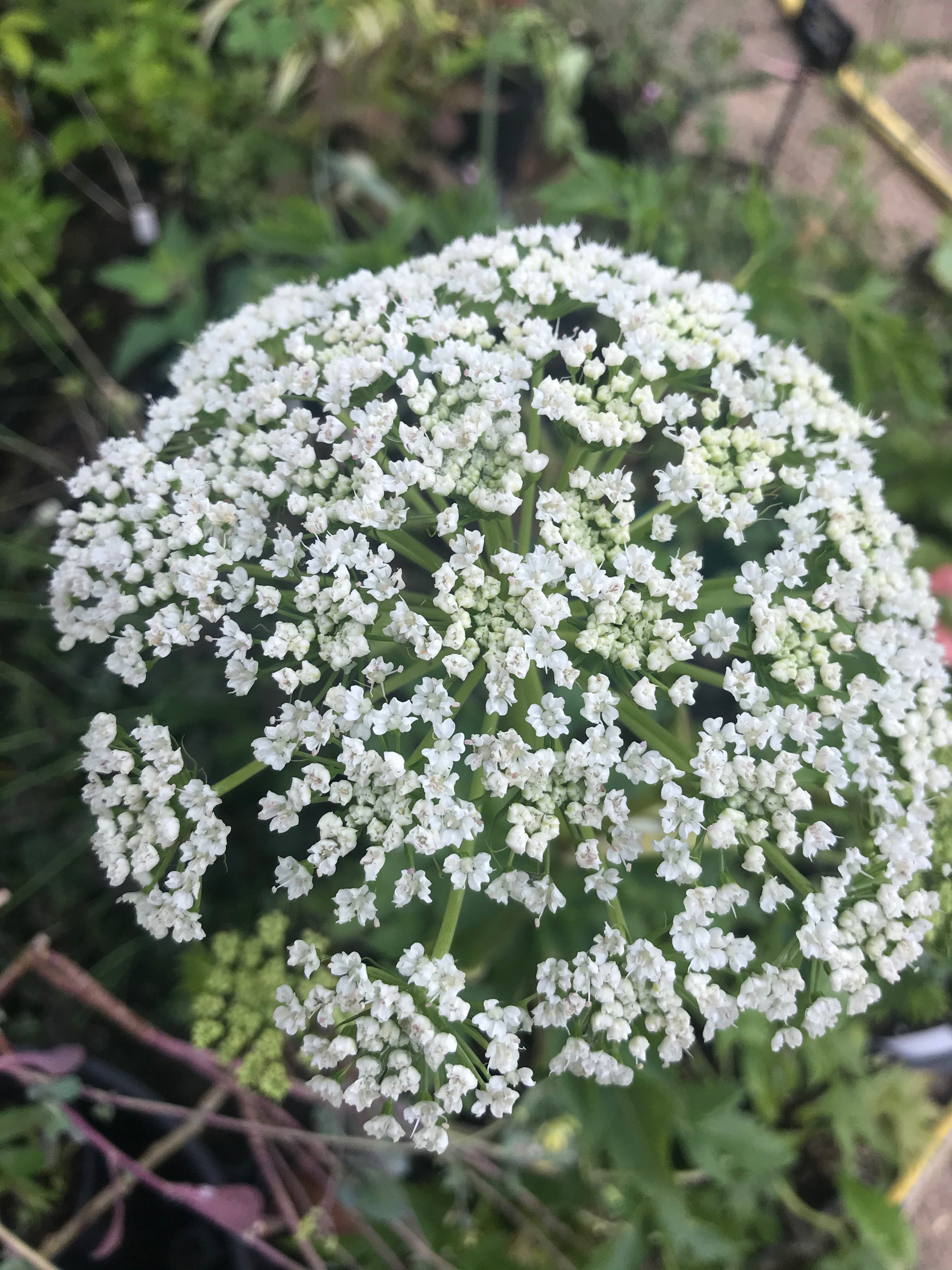
Dystaenia takishimana KOREAN CELERY
Korean Celery Apiaceae
Korean perennial celery with an identity crisis — it looks like a giant parsley, tastes somewhere between celery and lovage, and apparently didn’t get the memo that celery is supposed to be boring. A magnificent member of the Apiaceae, this little-known perennial forms a substantial clump of finely divided, glossy foliage before sending up strong, branching stems to around 1.5–2m. Broad, flat-topped umbels of small white flowers appear in summer, attracting a host of pollinating insects. Endemic to Ulleungdo, a volcanic island off the east coast of South Korea, it is one of those rare plants that manages to be both genuinely ornamental and genuinely useful.
Range: Dystaenia takeshimana is endemic to Ulleungdo (Ullung Island), South Korea, where it occurs throughout the island. It is the Korean species of the small genus Dystaenia; the other accepted species, D. ibukiensis, occurs in Japan.
Edible: The young leaves and stems are edible and have a flavour described as a mixture of celery and lovage. The RHS records harvesting from autumn through spring, even during cold winters, with the nutritious leaves and stalks useful in soups and stews; the young foliage can also be used as a substitute for flat-leaved parsley. On Ulleungdo, ethnobotanical records document the young shoots being soaked and parboiled, while leaves are also fermented in soy sauce or soybean paste.
Ethnobotany: Known locally as seombadi (섬바디), the plant has traditionally been important on Ulleungdo as a food and forage plant, and its roots have also been used in traditional Korean medicine. It was formerly regarded as a useful pasture plant, although cultivation for forage was abandoned because of practical difficulties.
Growing conditions: Surprisingly accommodating. Grow in a moist but well-drained, fertile soil in sun or semi-shade. Give it room: this is not a dainty little celery substitute but a substantial perennial capable of reaching 2m. Once established it makes a bold architectural plant, while the finely divided foliage keeps the overall effect lighter than its size might suggest.
Garden use: Excellent towards the back of a herbaceous border, in a productive garden or anywhere a large, airy umbellifer is wanted. The white flower umbels are excellent for pollinators, while the edible foliage gives it an unusual degree of usefulness. A particularly good plant for the gardener who believes that ornamental and edible should never have been mutually exclusive categories.
Flowering: July–September
Hardiness: H7, below -20°C
Height: 150–200cm
Spread: 80–120cm
- Standard delivery: £9.99
- Free shipping on orders over £100
- Minimum order is £20
Read more: Shipping & Delivery