

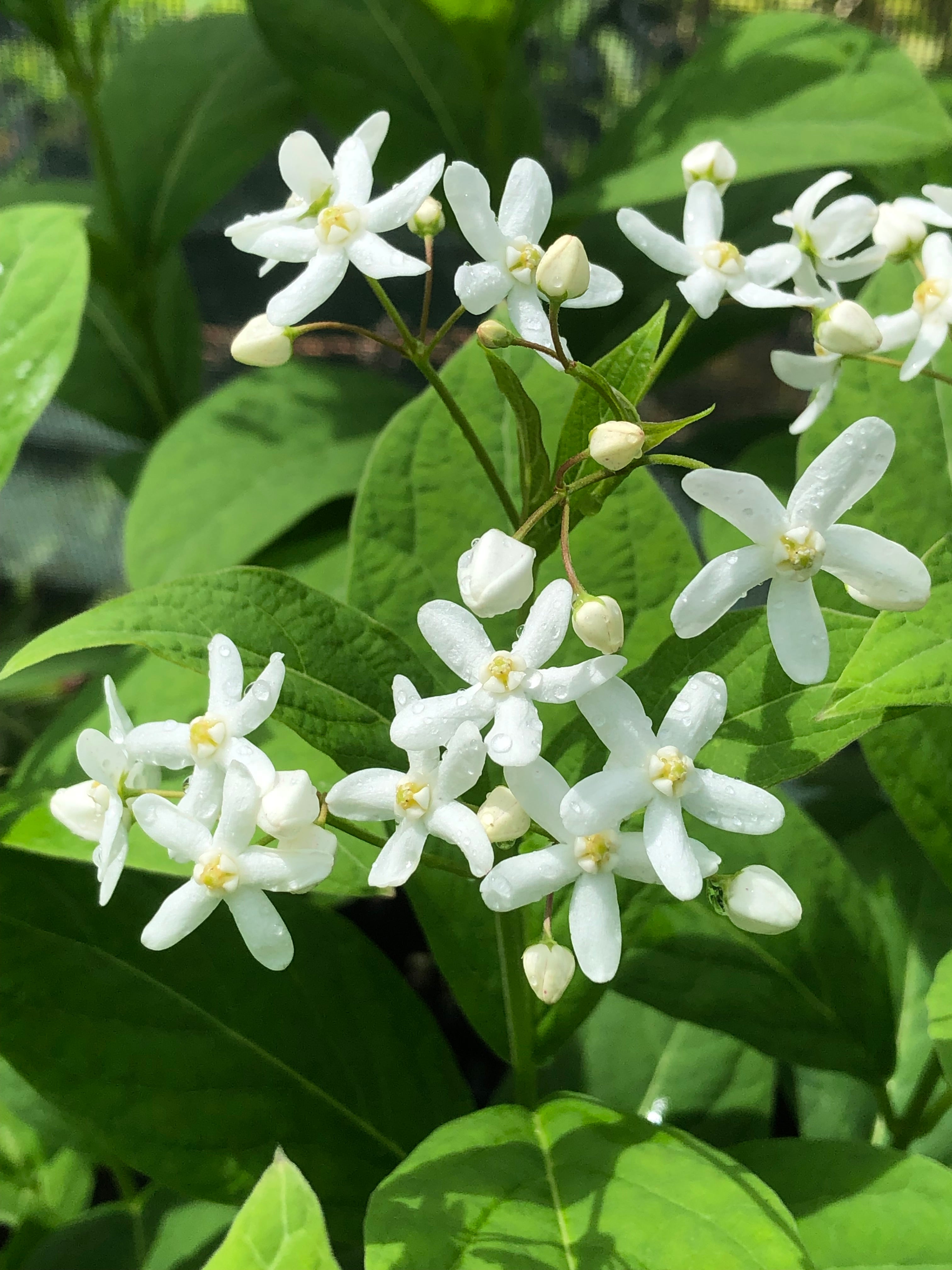
Cyananchum ascyrifolium
Mosquito Trap Plant Apocynaceae
a rather discreet member of the milkweed family, but one with considerably more going on beneath the surface than its modest appearance suggests. Now generally treated by some authorities under the name Vincetoxicum ascyrifolium, it is a herbaceous perennial of eastern Asia, occurring in China, Korea, Japan and the Russian Far East, including Primorye and Khabarovsk. It grows in sunny grassland, open woodland and along woodland margins, often on well-drained soils.
The upright stems carry narrow, pointed leaves and clusters of small, rather intricate flowers, giving it a distinctly refined, almost architectural appearance. Its ethnobotanical history is particularly interesting: the roots have been used in Chinese and Korean traditional medicine, forming one of the recognised botanical sources of the crude drug Baiwei (白薇), traditionally employed principally as an antipyretic and diuretic. Korean pharmacognostic work has confirmed C. ascyrifolium as one of the species contributing roots to this medicine. (Korean Traditional Knowledge Portal) Chinese herbal references also record the roots for uses including clearing heat, promoting urination and treating sores. (baoantang.com)
An intriguing plant for the serious collector, therefore, combining an understated woodland-garden presence with a surprisingly substantial ethnobotanical history. Not for culinary use: members of Cynanchum contain biologically active steroidal compounds, and traditional medicinal use should not be confused with evidence of safety for self-medication. (PubMed Central (PMC))
Flowering: June–August
Hardiness: H5, approximately –15 to –10°C
Height: 50–80cm
Spread: 30–45cm
Range: China, Korea, Japan and Russian Far East
Ethnobotany: Roots used traditionally in Chinese and Korean medicine, including as Baiwei (白薇), principally for fever and urinary complaints
- Standard delivery: £9.99
- Free shipping on orders over £100
- Minimum order is £20
Read more: Shipping & Delivery