

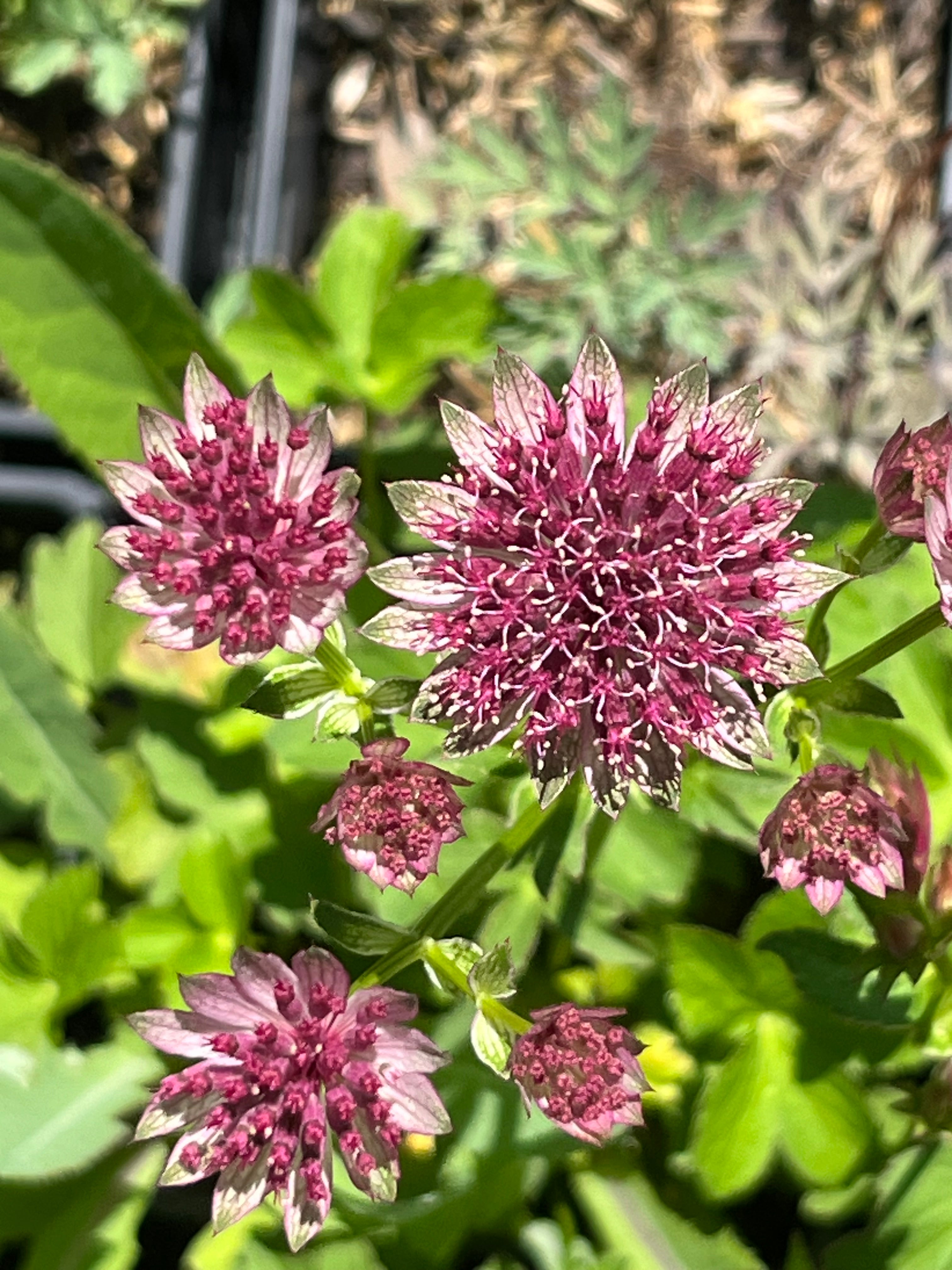
Astrantia major ‘Roma’
Masterwort Apiaceae
A particularly good masterwort, and one that has earned its place in the catalogue rather than merely turning up because somebody happened to give a nice seedling a name. ‘Roma’ produces upright, branching stems carrying elegant pincushion-like flowerheads of reddish-pink florets surrounded by a broad ruff of silvery-pink to pale pink bracts. The effect is wonderfully delicate from a distance, but close inspection reveals the intricate construction that makes Astrantia such a useful garden plant.
It is also notably long flowering. The first flowers appear in early summer and, with deadheading, the plant can continue producing fresh heads well into late summer and sometimes autumn. The bracts remain attractive after the tiny central flowers have faded, making ‘Roma’ particularly good both in the border and as a cut or dried flower.
The plants form compact clumps of deeply divided, dark green foliage, with the wiry flower stems rising to around 50–60cm. It is an excellent choice for the classic Astrantia situation: moist, fertile soil in sun or light shade. Unlike many supposedly shade-loving plants, it will flower very well in sun provided it does not dry out. The RHS specifically recommends moist, fertile, humus-rich soil and lists ‘Roma’ as H7 hardy.
Introduction & nomenclature
‘Roma’ originated from a planned breeding programme in Hummelo, Netherlands, with the cross made in 1992 by the Dutch breeder Cees van der Zalm. The original breeding objective was to produce Astrantias with unusual flower colours, early flowering and a long, continuous flowering period. The pollen parent was Astrantia major ‘Ruby Wedding’, crossed with an unnamed selection of A. major var. involucrata according to the original US patent.
Interestingly, later plant records simplify the parentage to A. major ‘Ruby Wedding’ × an unnamed A. major selection. For catalogue purposes, therefore, ‘Roma’ is best regarded as a deliberately bred Astrantia cultivar within the A. major complex, rather than implying that it is a wild-form species or a chance seedling.
The name ‘Roma’ is simply the cultivar epithet; it is not a botanical rank. The genus Astrantia belongs to the Apiaceae, the carrot family — although looking at those rather extravagant pincushion flowers, it is perhaps the least carrot-like member of the family.
Height: 50–60cm
Spread: 40–50cm
Flowering: June–September
Aspect: Sun or partial shade
Soil: Moist, fertile, humus-rich; tolerates clay
Hardiness: H7
Uses: Herbaceous borders, naturalistic planting, cut flowers and dried arrangements
A superbly reliable Astrantia with unusually clear colouring and an exceptionally long flowering season. ‘Roma’ may sound glamorous, but unlike its namesake it doesn’t require an empire to keep it happy — just decent soil and a little moisture.
- Standard delivery: £9.99
- Free shipping on orders over £100
- Minimum order is £20
Read more: Shipping & Delivery