

Aristotelia chilensis
Macqui, Chilean Wineberry Elaeaocarpaceae
A handsome evergreen shrub or small tree from southern South America, Aristotelia chilensis, commonly known as maqui, is grown both for its attractive foliage and for its remarkable edible fruit. The young stems are often reddish, carrying opposite, glossy dark green leaves with finely serrated margins, while small cream-yellow flowers are followed on female plants by clusters of succulent, purple-black berries. The fruit is sweet, juicy and intensely coloured, ripening in mid summer and particularly attractive to birds.
Maqui has a long history of use by the Mapuche people of Chile, for whom it is regarded as a culturally important and sacred plant, associated with peaceful and benevolent intentions. The berries have traditionally been eaten fresh and also made into drinks, preserves and fermented beverages, while their exceptionally dark colour has historically been used to deepen the colour of wine. The leaves have been used medicinally in traditional preparations, including infusions and fresh leaf preparations for sore throats, mouth ulcers, fever and digestive complaints, while crushed leaves have also been used externally for wounds.
The fruit has attracted considerable modern interest because it is exceptionally rich in anthocyanins and other polyphenolic compounds, giving the berries their intense violet-black colour. Maqui berries are now marketed internationally as a food ingredient, although much of the traditional supply has historically come from wild harvesting.
Native to Chile and adjoining parts of Argentina, A. chilensis has a remarkably broad ecological range, occurring from near sea level into the mountains. It is dioecious, so male and female plants are required for reliable fruit production. In cultivation it makes a useful evergreen shrub, responding well to pruning and capable of becoming a small tree if allowed to develop naturally.
A fascinating plant for the edible and ethnobotanical garden, combining ornamental evergreen foliage with genuinely useful fruit and a deep cultural history. It prefers a fertile, moisture-retentive soil and is particularly vigorous where summers are not excessively dry.
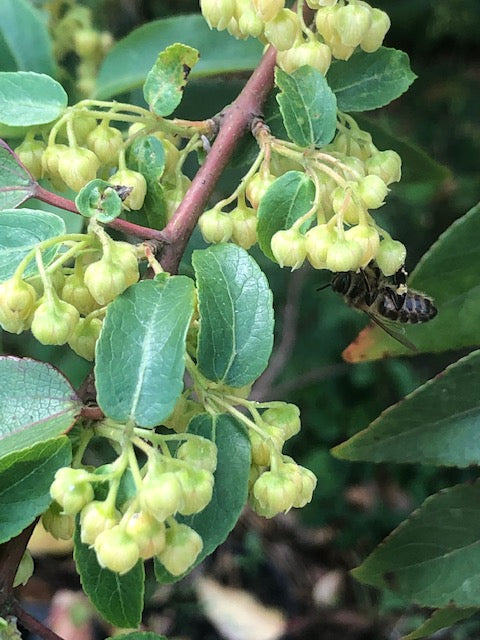
We have planted this out in very exposed positions without issue on the Berkshire Downs. It is also very attractive to bees.
The species is generally described as dioecious, with male and female flowers occurring on separate plants, but its reproductive biology appears more complex. Hermaphroditic individuals and flowers have been recorded, and some populations have been described as subdioecious. Our own plants do not show an obvious separation into male and female individuals, an observation which is consistent with these reports of greater sexual variability.
Height: 3–5m
Spread: 2–3m
Flowering: May–June
Fruiting: July - August
Position: Sun or partial shade
Soil: Fertile, moist and well drained
Hardiness: Approximately H4–H5
- Standard delivery: £9.99
- Free shipping on orders over £100
- Minimum order is £20
Read more: Shipping & Delivery