

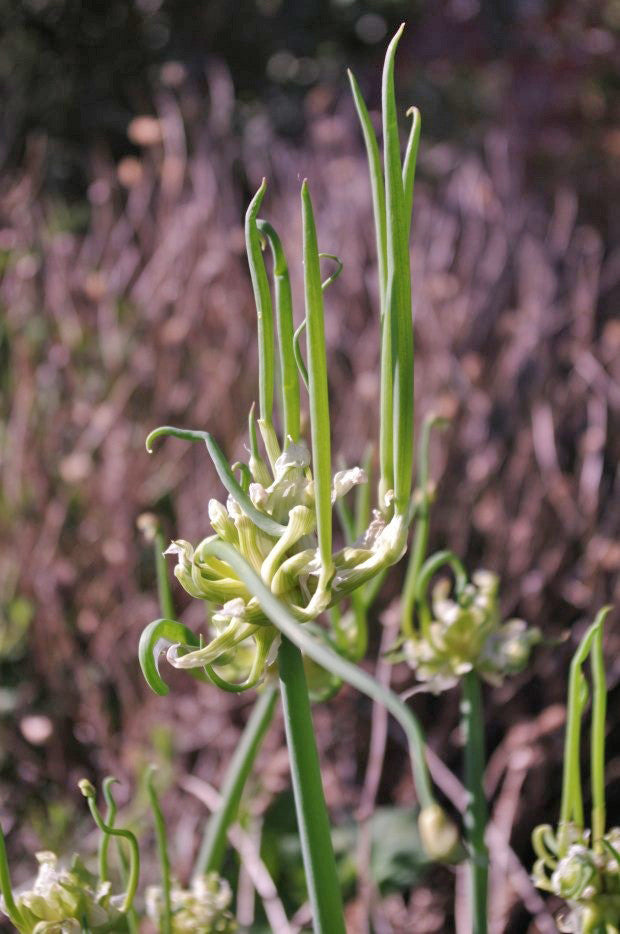
Allium cepa Proliferum Gp (TREE ONION)
Egyptian Tree Onion Amaryllidaceae
A wonderfully useful and slightly eccentric perennial onion that produces small edible bulbils at the top of its flowering stems, rather than relying solely on flowers and seed. As the season progresses these little onions swell, sometimes becoming so heavy that the stems bend towards the ground, where the bulbils root and establish new plants — hence the wonderfully descriptive name ‘Walking Onion’. The plant is, in effect, perfectly capable of planting its own replacements.
It forms a substantial clump of thick, cylindrical, grey-green leaves, with the stems reaching up to around 1.5 m. The underground bulbs can be harvested as small onions, while the young foliage makes an excellent spring-onion substitute. The aerial bulbils are also edible and can be used fresh, cooked or pickled.
Nomenclature: The RHS currently treats this as Allium cepa Proliferum Group, with Allium cepa var. prolifera among the synonymous names. It is also widely encountered under Allium × proliferum, Allium cepa var. viviparum and Allium cepa var. bulbiferum. There has been considerable taxonomic debate over its precise origin, with A. × proliferum often treated as involving A. cepa × A. fistulosum. For horticultural purposes, A. cepa Proliferum Group is a useful and widely recognised treatment.
The Latin proliferum means ‘producing offspring abundantly’ — an unusually accurate piece of botanical nomenclature. This onion produces bulbils above ground while also multiplying below ground, so it has rather enthusiastically covered both bases.
Ethnobotany & edible uses: Cultivated for centuries as a perennial vegetable, particularly valued where a reliable supply of onions is wanted without annual replanting. The young leaves and white leaf bases can be eaten as spring onions, while the underground bulbs and aerial bulbils can be used like small onions or preserved by pickling.
The bulbils are particularly useful: harvested young they are crisp and strongly flavoured, while mature bulbils make excellent pickling onions. Allow some to remain on the plant and they will obligingly provide next year’s crop themselves.
Height: 1–1.5 m
Spread: 30–50 cm
Flowers: June–August
Hardiness: H4; hardy through most of Britain
Best grown in full sun in fertile, moisture-retentive but well-drained soil. Plant the aerial bulbils in autumn or spring, and within a remarkably short time you will have another clump. It is worth giving it some room — not because it is particularly invasive, but because it is exceptionally enthusiastic about making more onions. Removing unwanted bulbils before they drop prevents it wandering around the garden.
A superb choice for the edible garden, allotment or kitchen garden, particularly for anyone interested in perennial vegetables and unusual heritage crops. Reliable, productive and almost comically self-sufficient.
The onion that plants itself, multiplies itself and then gives you something to eat. Frankly, all it needs now is to cook dinner.
- Standard delivery: £9.99
- Free shipping on orders over £100
- Minimum order is £20
Read more: Shipping & Delivery