

Allium ampeloprasum var. babingtonii
Babington’s Leek Amaryllidaceae
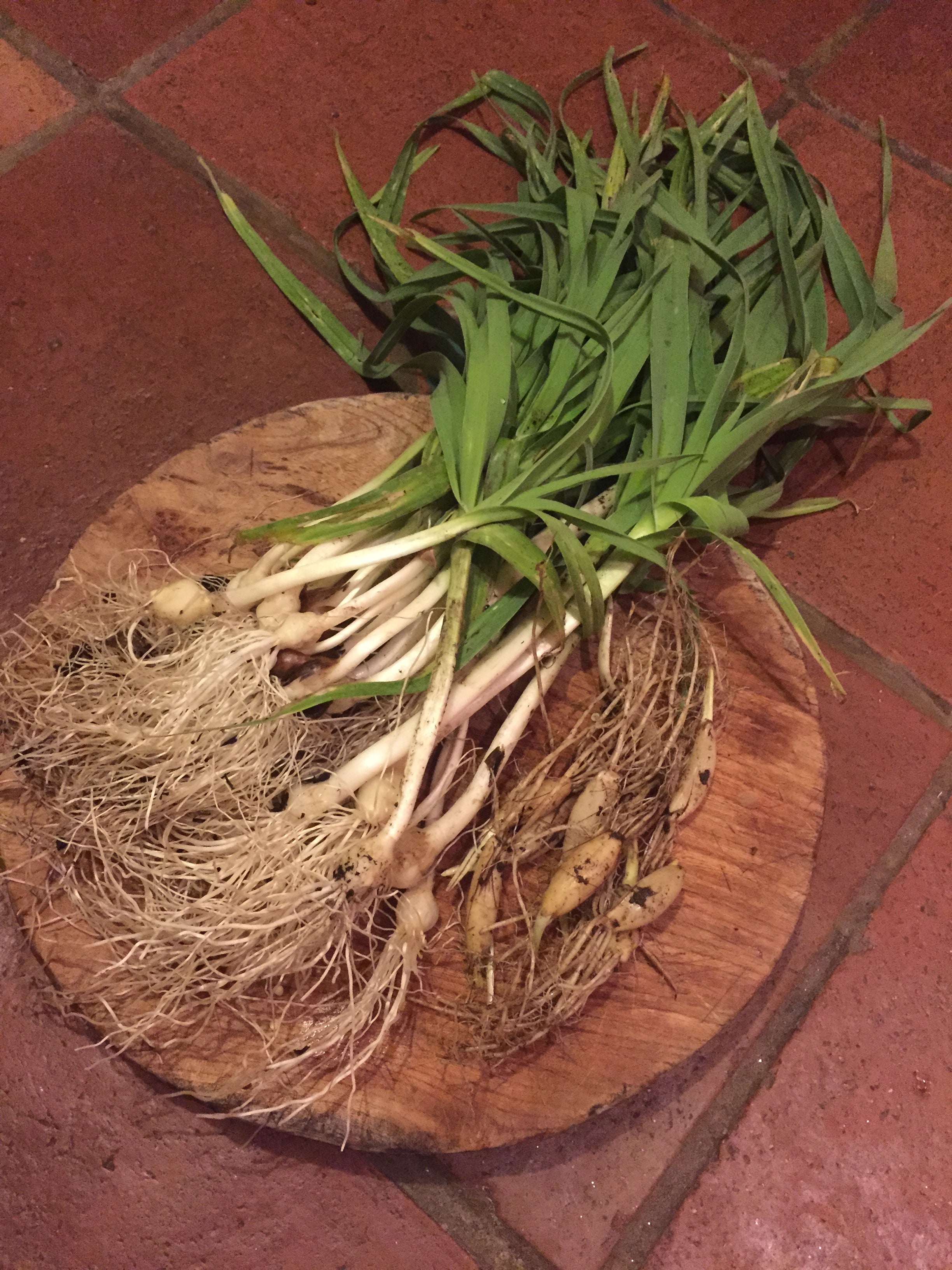
A particularly intriguing piece of British botanical heritage, Babington’s Leek is the remarkable bulbiferous wild leek of south-west Britain and Ireland. It forms substantial clumps of long, grey-green, strap-shaped leaves, followed in summer by tall, sturdy stems carrying loose spherical heads of pale lilac flowers. What makes it especially curious, however, is what happens in the flower head: instead of relying principally on seed, the flowers are accompanied by numerous small bulbils, which drop or are dispersed to produce new plants. It is therefore a leek that has, rather sensibly, decided to dispense with the bother of making viable seed.
The name has an appropriately distinguished botanical history. The varietal epithet babingtonii commemorates Charles Cardale Babington (1808–1895), the eminent English botanist, Cambridge professor and author of the Manual of British Botany. Babington was one of the great nineteenth-century students of the British flora, and his name is commemorated in a number of plants.
Native principally to south-west Britain and western Ireland, it is particularly associated with Cornwall, the Isles of Scilly and parts of Wales. It occurs in a surprisingly broad range of habitats, from coastal grassland and cliff tops to hedgebanks, old fields and disturbed ground. Despite its maritime associations, it is by no means a plant requiring salt spray and can make an excellent garden subject.
Its biology is even more interesting. Allium ampeloprasum is an extraordinarily variable species, encompassing the cultivated leek and several distinctive wild forms. Babington’s Leek is effectively sterile and predominantly clonal, reproducing through bulbils and offsets rather than conventional seed. Research into populations in south-west England has found remarkably little genetic variation, supporting the idea that plants occurring across widely separated sites may represent an ancient and extraordinarily persistent lineage. This has led to considerable interest in its possible relationship with cultivated leeks and in the history of human selection and movement of A. ampeloprasum.
For the kitchen garden it has genuine merit. The young leaves, bulbs and bulbils are edible, with a flavour somewhere between leek and mild garlic. The bulbils can be used much like small onions and provide the plant with its wonderfully easy means of propagation. It is consequently an excellent choice for anyone interested in perennial vegetables, heirloom crops or the conservation of old forms of edible plants.
In cultivation it is an easy, robust perennial, best given full sun and a fertile but well-drained soil. Once established it forms impressive clumps and, if allowed to naturalise, will gradually establish itself through its bulbils. The flowering stems are sufficiently tall to give it considerable architectural presence, while the unusual bulbiferous heads reward close inspection. It is fully hardy in Britain and remarkably persistent once established.
Height: 1.5–2 m
Spread: 30–50 cm
Flowers: June–August
Hardiness: Fully hardy; approximately –15 to –20°C
Uses: Edible leaves, bulbs and bulbils; perennial vegetable; naturalising; botanical and heritage collections
Propagation: Bulbils and offsets; essentially sterile by seed.
- Standard delivery: £9.99
- Free shipping on orders over £100
- Minimum order is £20
Read more: Shipping & Delivery